Key Takeaways & Essential Logistics (TL;DR)
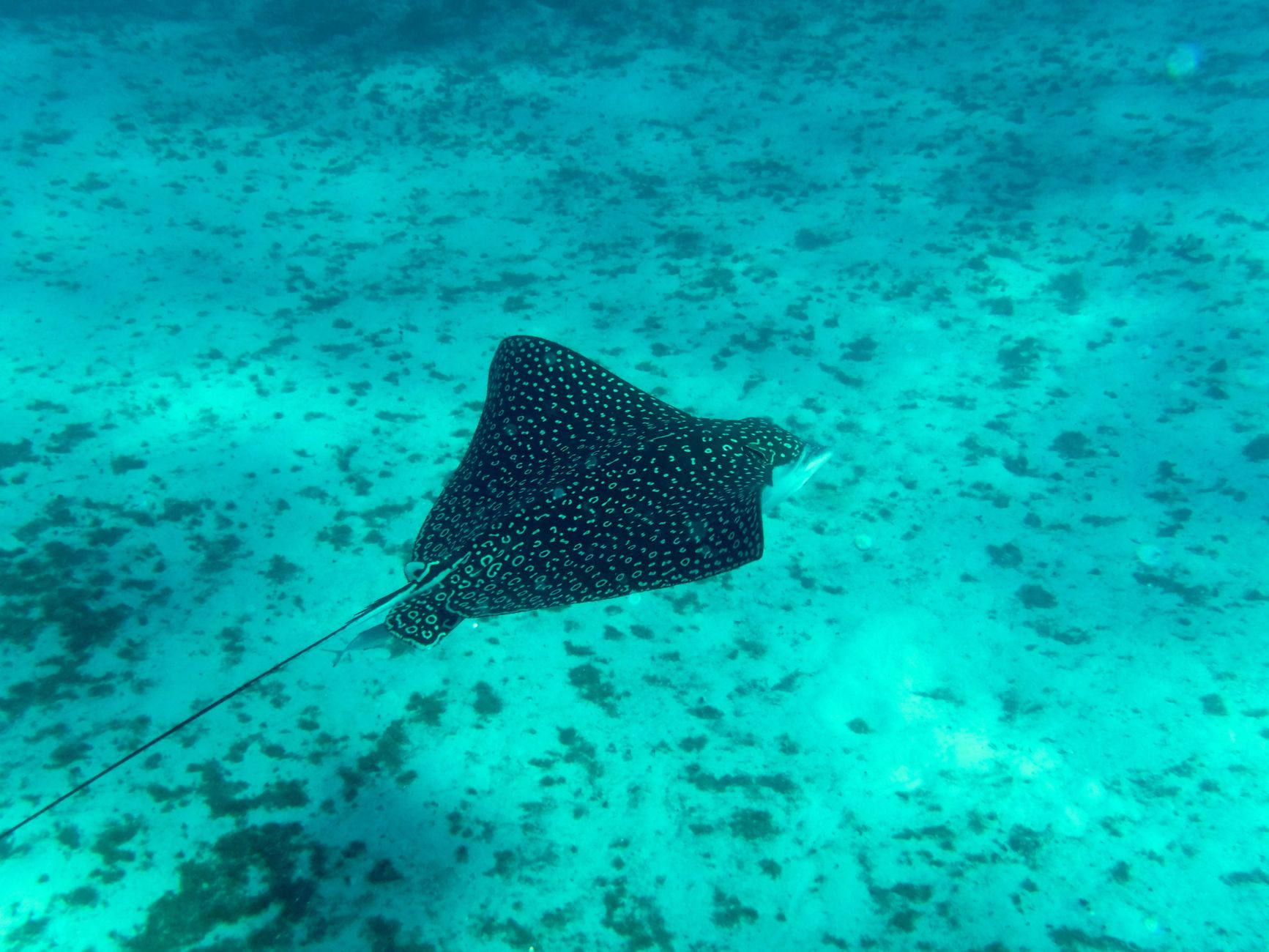
- Completely Wild Population: The stingrays of Grand Cayman are not captive, trained, or fenced. The July 2025 DoE bi-annual census confirmed 92 resident southern stingrays freely aggregating at the shallow Sandbar.
- Fishermen’s Accidental Sanctuary: The attraction originated in the 1930s to 1950s when local artisanal fishermen anchored behind the North Sound barrier reef to clean fish and conch, conditioning nocturnal rays to associate boat engine vibrations with food scraps.
- Pronounced Female Dominance: Over 80% of resident sandbar stingrays are mature females. Females grow more than double the size of males, weighing up to 75 pounds (34 kg) with wingspans exceeding 4 feet (1.2 m).
- The COVID-19 Habitat Shift: During Grand Cayman’s 21-month border closure (2020–2022), supplemental feeding was maintained exclusively at the shallow 3-foot Sandbar. Consequently, the rays abandoned the deep 12-foot dive site, consolidating almost entirely into the shallow wading zone.
I’m Captain Dave. Growing up in West Bay in the 1970s and 1980s, I listened to our elder fishermen tell stories of how the North Sound barrier reef changed from a quiet, solitary fishing ground into the premier marine ecotourism site on Earth.
To truly appreciate your encounter at Stingray City, you have to understand the extraordinary evolutionary biology of the southern stingray (Hypanus americanus) and the unique historical accident that brought wild apex bottom-feeders into peaceful, daily contact with humans.
Here is the authentic scientific and historical breakdown of our world-famous sandbar.
1. The History: How Fishermen Created Stingray City
Stingray City was not engineered by marine biologists, resort developers, or government planners. It began as an accidental byproduct of artisanal Caymanian seamanship.
Phase 1: Mid-20th Century Fishing Cleaning Grounds (1930s–1950s)
In the mid-20th century, before refrigerator freezers were commonplace on fishing boats, Caymanian fishermen returned from long expeditions across the Caribbean Sea and dropped anchor just inside the tranquil shallows behind the North Sound barrier reef.
Inside the reef, protected from rolling open-ocean swells, fishermen gutted their catch of snapper, grouper, and queen conch, shoveling offal, fish guts, and conch scraps over the gunwales.
Southern stingrays – naturally nocturnal, solitary bottom-dwellers – gradually learned that the drone of inboard and outboard marine engines signaled a free, effortless feast. Over decades, generations of stingrays shifted their foraging behavior, gathering in the shallows whenever boat hulls appeared on the horizon.
Phase 2: Captain Marvin’s Pioneering Excursions (1951)
In 1951, a legendary West Bay mariner named Captain Marvin Ebanks returned from working commercial ships abroad and launched Grand Cayman’s earliest recreational “North Sound Excursions.” Joined by fellow West Bay captains Gleason, Ertis, and Solomon, Captain Marvin took pioneering travelers across the sound for conch-diving and served open-fire seafood lunches under the trees at Rum Point.
Phase 3: The 1987 Diving Breakthrough
By the early 1980s, local scuba instructors realized that the rays congregated in deeper water near the barrier reef channel. In 1981, divemasters Pat Kenney and Jay Ireland began testing direct underwater feeding interactions.
In early 1987, operations manager Ron Kipp of Bob Soto’s Diving invited Skin Diver magazine publisher Paul Tzimoulis and celebrated underwater photographer Geri Murphy Tzimoulis to dive the 12-foot site (then nicknamed “Valley of the Rays”).
Upon climbing the boat ladder, stunned by the dozens of circling animals, Geri Murphy exclaimed, “This is a Stingray City!” formally christening the site. Skin Diver published a landmark cover feature declaring it the “Best 12-Foot Dive in the World,” sparking an international tourism sensation.
2. The COVID-19 Structural Shift: Deep Site to Shallow Sandbar
One of the most profound ecological events in the sandbar’s history occurred between April 2020 and February 2022, when the Cayman Islands closed its borders to all cruise tourism for 21 months during the pandemic.
During this tourism pause, the Cayman Islands Department of Environment (DoE) recognized that habituated stingrays could suffer malnutrition if abruptly cut off from supplemental feeding. Conservation officers conducted regular feeding runs – but exclusively at the shallow 3-to-5-foot Sandbar WIZ, bypassing the deeper 12-to-15-foot scuba dive site.
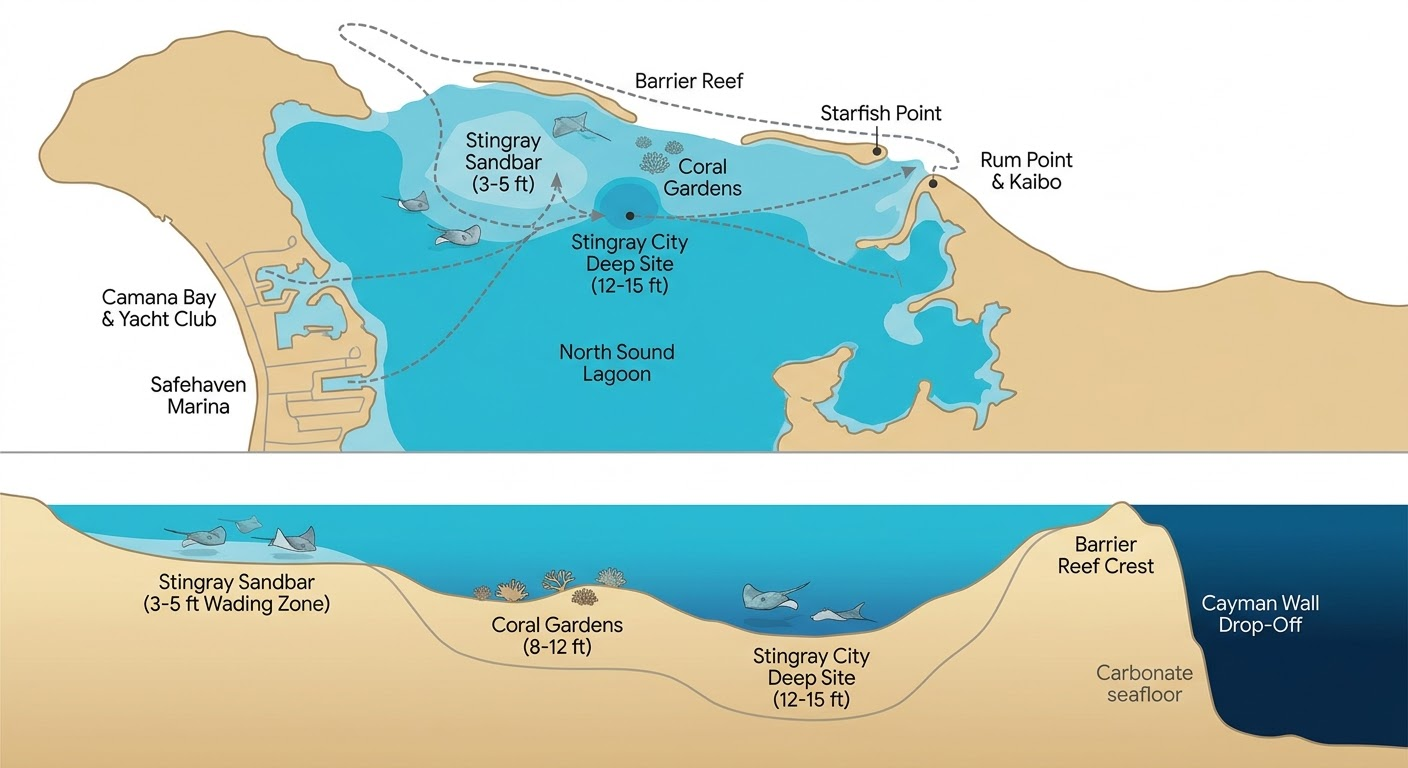
As illustrated in our underwater bathymetry diagram:
- The Deep Site (12–15 ft): Today, the original “Valley of the Rays” dive site is largely defunct, retaining only 3 to 4 resident rays visited by occasional private sailboats.
- The Shallow Sandbar (3–5 ft): Over 98% of the North Sound stingray population permanently migrated into the shallow wading zone. The July 2025 census documented 92 verified individuals, proving the population has remained remarkably stable, healthy, and resilient.
3. Marine Biology of the Southern Stingray (Hypanus americanus)
Southern stingrays belong to the class Chondrichthyes – cartilaginous fish whose skeletons are made of flexible cartilage rather than calcified bone, placing them in the same ancient evolutionary lineage as sharks.
A. Sensory Wonders: The Ampullae of Lorenzini
Stingrays possess one of the animal kingdom’s most sophisticated hunting arsenals. Because their eyes are located on top of their head and their mouth is underneath, they cannot see the prey they are eating.
Instead, they navigate and locate food using:
- Ampullae of Lorenzini: Tiny, gel-filled pores clustered around their snout that detect micro-electric impulses generated by the muscle movements and heartbeats of buried crabs, worms, and clams.
- Exceptional Olfaction: Highly sensitive scent receptors that track chemical trails in moving water from hundreds of yards away.
B. Size Disparity: Giant Matriarchs vs. Small Males
Southern stingrays exhibit extreme sexual dimorphism:
- Females (The Giants): Female rays at the sandbar are massive, commonly reaching disc widths of 3.5 to 5 feet (1.0 to 1.5 m) and weights of 60 to 75 pounds (27 to 34 kg). They are gentle, docile, and move slowly through the shallows.
- Males (The Agile Sprinters): Male rays rarely exceed 2 feet in disc width and weigh only 15 to 25 pounds. They are noticeably faster, darting between the females during the summer mating season.
C. The Venomous Barb: Anatomy & Function
The stingray’s defensive weapon is a serrated, venom-coated spine situated along the base of its tail.
- The barb is covered in an integumentary sheath containing protein-based toxins.
- Rays naturally shed and regenerate their barb once or twice a year, similar to a shark losing and replacing teeth.
- Because rays on the Sandbar feel safe and are accustomed to gentle, flat-handed touching, they keep their tails relaxed behind them, never raising their spines unless stepped on directly.
4. Scientific Monitoring & Conservation Challenges
While ecotourism generates an estimated $500,000 USD per resident stingray per year for the Caymanian economy, ongoing research by the Guy Harvey Ocean Foundation and the DoE documents real physiological trade-offs:
- Dietary Specialization: In the wild, rays consume a varied, mineral-rich diet of blue crabs, mantis shrimp, and clams. At the sandbar, their diet consists primarily of imported thawed squid. While high in protein, exclusive squid feeding causes elevated cholesterol, altered fatty acid profiles, and oxidative stress. To counter this, the DoE sets strict daily feeding quotas for commercial operators.
- Behavioral Inversion: Wild stingrays are solitary, nocturnal hunters. The Sandbar population has adapted to a dense, diurnal schedule synchronized with morning and afternoon boat arrivals.
- Propeller Safety: Because rays associate boat engine sounds with food, they freely approach idling vessels. The Cayman Islands requires all permitted commercial tour boats to maintain strict shallow-water idle speeds and install propeller shrouds or tunnel-hull drives to eliminate blade injuries.
Red Flags & What to Avoid at Stingray City
- Never Touch the Central Tail Spine: While petting a stingray’s velvety wings is encouraged, always keep your hands away from the tail base where the defensive barb is seated.
- Do Not Support Unpermitted Tour Boats: Vessels operating without an annual DoE WIZ permit do not adhere to squid feeding quotas, endangering the long-term nutritional health of the rays.
5. Frequently Asked Questions About Stingray Biology
How long do southern stingrays live?
How do stingrays reproduce?
Can stingrays see what they are eating?
Experience These Marine Wonders in Person
Book an educational, small-group eco-tour led by certified Caymanian naturalists:
📊 1. Verified 2026 Excursion Comparison Matrix
Compare Grand Cayman's top-rated, licensed fleet—vetted for small passenger counts, senior-friendly boarding staircases, transparent pricing, and guaranteed on-time cruise return.
 🏆 #1 Bestseller
Stingray City Experience + 2 Snorkel Stops
- ⏱ Duration: 3.0 Hours
- 🚤 Vessel: Motor Catamaran (40–45 pax)
- 📍 Stops: Sandbar + Coral Gardens + Reef
- 🚌 Port Transfer: Included from George Town Port
- 🤿 Snorkel Gear: Mask, snorkel, vests & squid bait
- 🪜 Boarding: Wide stern stairs with handrails
 ⭐ Classic 3-Stop
Sandbar, Starfish Point & Reef Sailing Catamaran
- ⏱ Duration: 3.5 Hours
- ⛵ Vessel: 65-ft Sailing Catamaran with sun nets
- 📍 Stops: Sandbar + Starfish Point + Coral Reef
- 🚌 Port Transfer: Included from Royal Watler Gate
- 🤿 Snorkel Gear: Premium snorkel set, punch & water
- 🪜 Boarding: Gentle staircase into the water
 💰 Best Value
Stingray & Starfish with Snorkel Adventure
- ⏱ Duration: 3.5 Hours
- 🚤 Vessel: Power Cruiser (Max 45 pax)
- 📍 Stops: Sandbar + Starfish Point + Coral Reef
- 🚌 Port Transfer: Included from George Town Port
- 🤿 Snorkel Gear: Standard snorkel gear & life vests
- 🪜 Boarding: Standard swim ladder with rails
 🌿 Small Group Eco
Boutique Sandbar & Coral Snorkel (Max 16 Guests)
- ⏱ Duration: 3.5 Hours
- 🚤 Vessel: Boutique Cruiser (Capped at 16–20)
- 📍 Stops: Sandbar + Starfish Point + Coral Gardens
- 🚌 Port Transfer: Included from Port & SMB Hotels
- 🤿 Snorkel Gear: Sanitized gear & personal floatation
- 🪜 Boarding: Dedicated in-water crew assistance
🏆 #1 Bestseller Excursion
Stingray City Experience + 2 Snorkeling Stops
⭐ Classic 3-Stop Adventure
Sandbar, Starfish Point & Reef Sailing Catamaran
💰 Best Value Choice
Starfish and Stingray City Adventure with Snorkeling
🌿 Small Group Eco (Max 16 Guests)
Boutique Sandbar, Snorkeling & Starfish Point
Ready to Experience Stingray City Sandbar?
Book an uncrowded 3-stop catamaran tour covering the Stingray Sandbar, Barrier Reef coral snorkeling, and Starfish Point with guaranteed on-time return to George Town Cruise Port.